Case study 03 · Brand launch & market entry · Tehran, 2020
Nobody Buys a First Edition
But they will pay to stand in the room where one is being designed. Before WINDOW existed — no date, no exhibitors, no history — we built a single evening in Tehran and let its architect explain it to the people who would have to fund it.
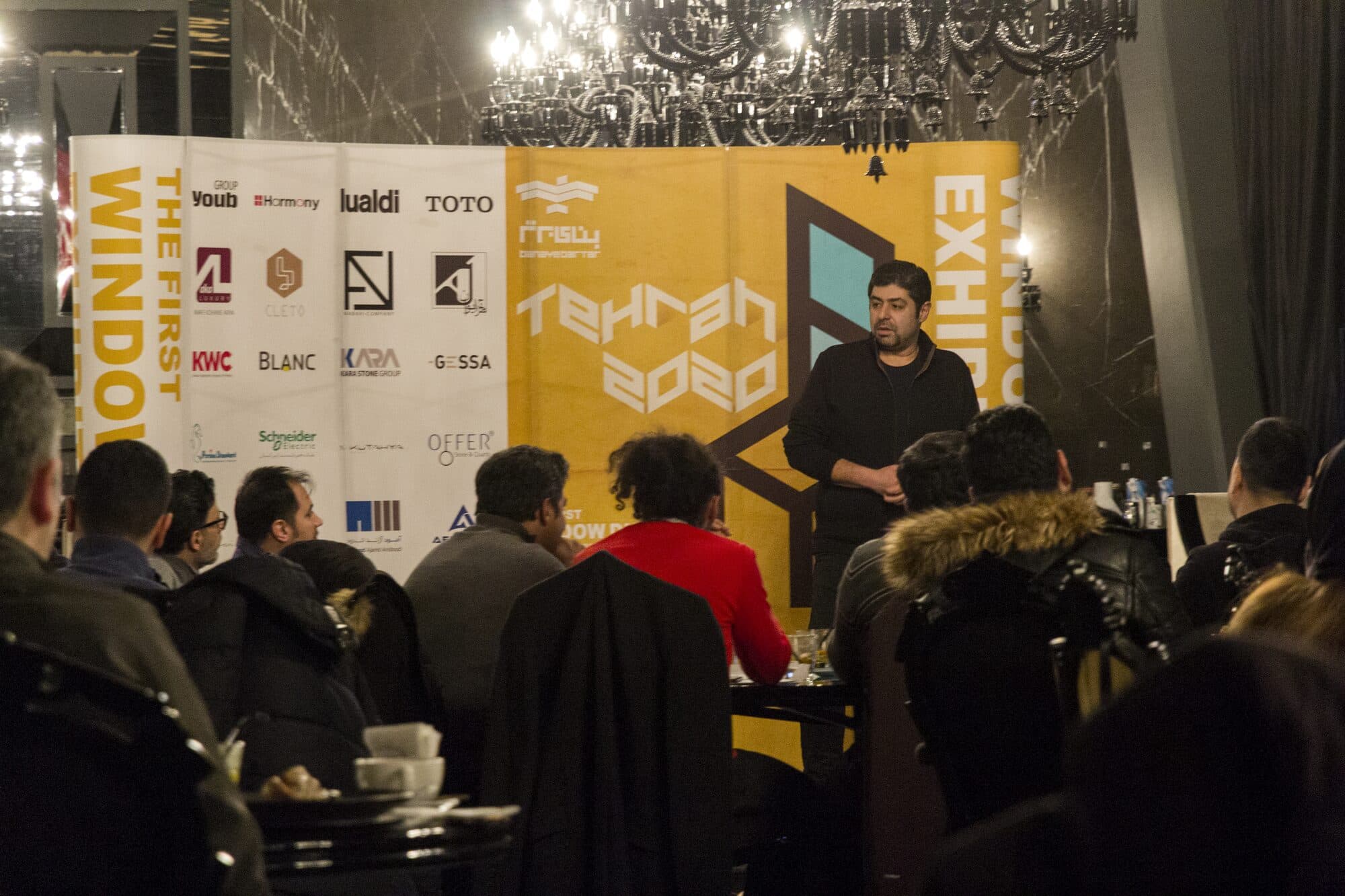
The brief
- The night
- Prelude to a New Chapter — a private unveiling
- The brand being launched
- WINDOW — a new exhibition format for Iran's building industry
- Created by
- Banaye Bartar Group
- Concept, positioning, experience design & host
- Ehsan Kaykhah
- Architect & presenter
- Sohrab Rafat
- Where
- Ava Center, Aghdasieh — Tehran
- When
- 19 January 2020, evening
- Guests
- Owners and senior leadership of Iran's building-material brands, by invitation only
- Sold on the night
- Nothing
At a glance
0 square metres sold
1 architect on stage
The setting
Iran's building industry is large, old and unusually social. Architects, structural engineers, developers and material manufacturers all sell to each other, and almost none of that trade happens online. It happens in rooms. Which is why the exhibition — the trade fair — has been the industry's central marketplace for forty years.
And for forty years it has been sold by the square metre. An organiser rents a hall, draws a grid on the floor, and sells the squares. What a brand does inside its square is the brand's own problem. The result is a hall of identical white boxes, differentiated by carpet colour and the size of the logo, where the most sophisticated manufacturers in the country present themselves like market stalls.
In 2020 we decided to build something else, and called it WINDOW.
Then we ran into the only problem that actually matters when you launch anything: it did not exist yet.
The default
A new exhibition in Iran launches the same way every time. You obtain the permit. You print a catalogue with a floor plan and a price list. You hand a phone list to a sales team. And then you call four hundred companies and ask them to buy a square in a hall that has never been used, on a date that has never been tested, from an organiser who has never done it.
There is only one argument available to you in that phone call, and everybody knows what it is. Discount. Nothing else is left. You have no attendance figures, no photographs, no exhibitor testimonials — nothing but a price you are willing to lower.
This is not stupidity. For an established organiser it is a perfectly rational machine, and it works, because the history does the persuading and the sales team only handles the paperwork.
For a brand with no history, the same machine does something else entirely. It asks the customer to absorb your risk, and it pays them for it in discount. And the moment a market meets you at a discount, it files you — permanently — in the category that discount belongs to. You will spend the next five years trying to climb out of a shelf you put yourself on in week one.
A launch does not open a market. It sets a ceiling.
A brand with no past has no proof. It has only a standard — and a standard cannot be described. It has to be entered.
You can say “this will be different” to four hundred companies on the phone and change nothing, because everyone says that and the sentence has no weight left in it. The only way to make a standard credible before it exists is to build a small, complete, finished instance of it, and put the people whose money you need physically inside it.
So we stopped preparing an announcement, and started designing one evening.
The moves
01
Frame it as a chapter, not a launch.
We named the night Prelude to a New Chapter. Not a launch event, not a press conference, not an unveiling of a company — the opening of a chapter in an industry the guests had built with their own careers. That framing did two things. It made the invitation an act of respect rather than a solicitation, and it made the guest a participant in the story rather than the target of it. Nobody in that room was being sold an exhibition. They were being told that their industry was entering a new period, and being asked to come and see what it looked like.
02
Put the architect on the stage. Never the sales team.
Sohrab Rafat presented WINDOW — the architect who had designed it, explaining what he had designed and why. This was the whole argument of the evening, compressed into one casting decision.
The audience was made of people who commission, manufacture and specify design for a living. In that room, a salesperson describing “a premium new exhibition experience” is noise. An architect walking through a spatial concept is a peer. And the choice announced the brand's priorities before a single claim was made: this is an organisation where design speaks first, and commerce speaks later, if at all.
It also settled something we could not have argued convincingly any other way. WINDOW's central claim was that an exhibition should be designed rather than allocated — as far as we know, the first time in Iran an exhibition had been given an architect at all, rather than a floor plan and a contractor. Claiming that in a press release is marketing. Having the architect stand up and present it is evidence.
03
Choose the room before you write the message.
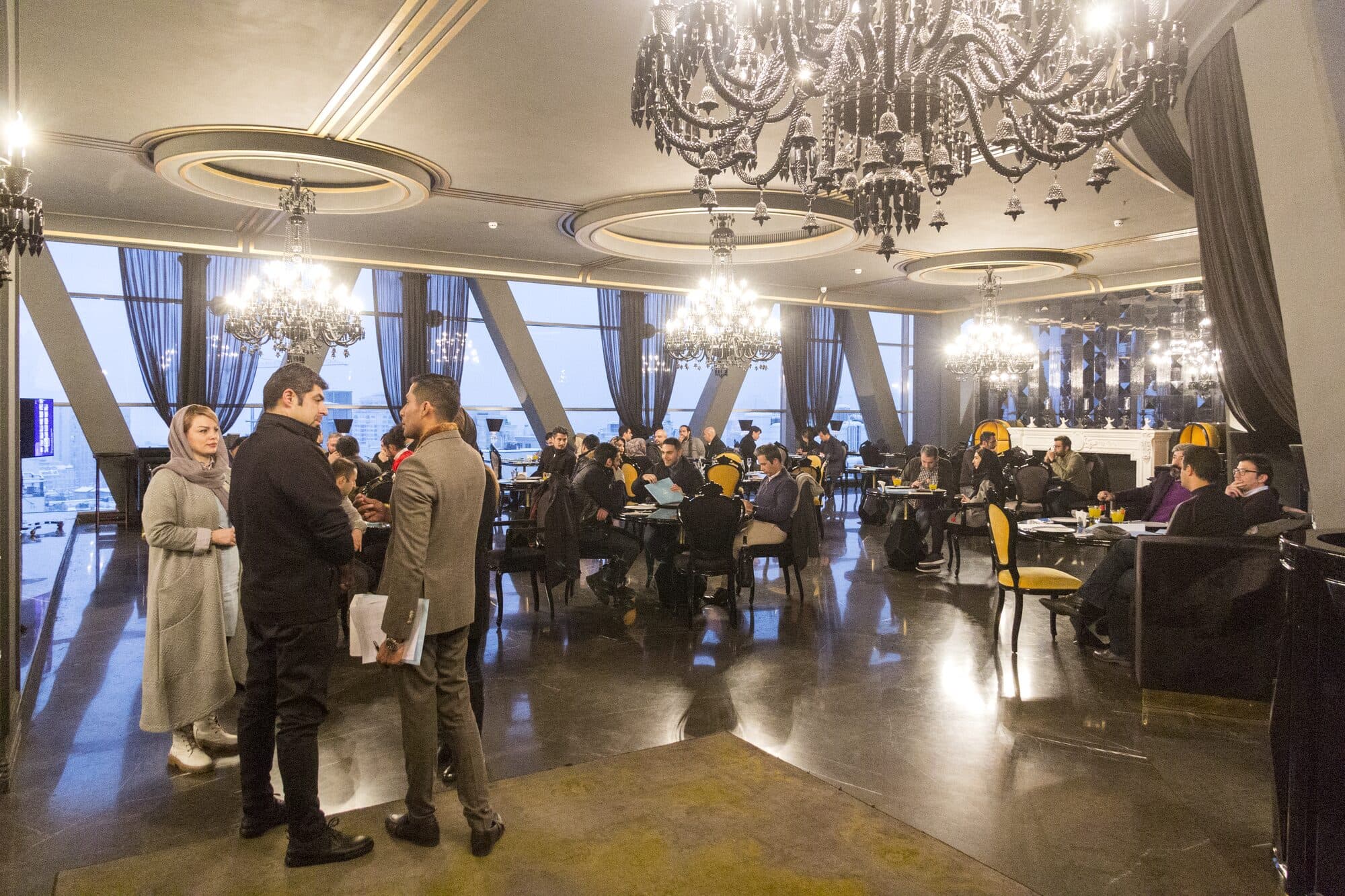
Not a hotel ballroom, not a meeting room at the fairground, not our own offices. Ava Center in Aghdasieh — a designed, private, north-Tehran setting, chosen because a guest reads a venue in about four seconds and has finished forming an opinion before anyone speaks.
Everything we intended to claim about WINDOW — curation, restraint, spatial quality, attention to how a person actually moves through a space — the venue said first, silently, at the door. When the words came later, they were confirming an impression rather than trying to create one. Argument that arrives after evidence is almost impossible to resist. Argument that arrives before it is just a claim.
04
Invite the market you want, not the market you can reach.
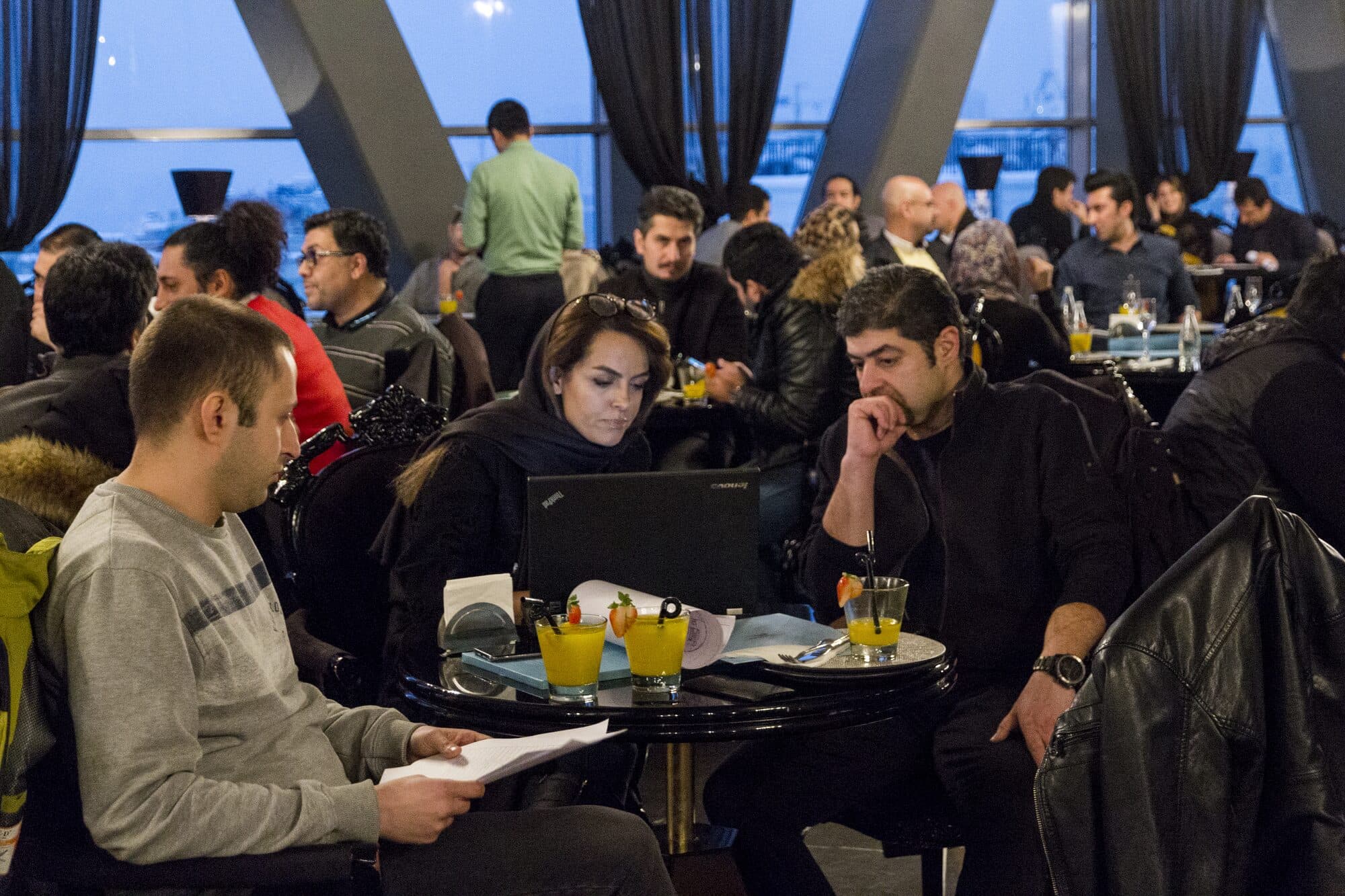
The guest list was owners and senior decision-makers at the country's building-material brands. Not marketing coordinators. Not “whoever the company sends.”
The reason is not snobbery, it is arithmetic. A new format cannot survive a chain of internal explanation — it is a spatial idea, and it dies somewhere between the person who saw it and the person who signs. So we removed the chain. Everyone in the room could say yes without asking anyone.
But the second effect was larger than the first. In a market this connected, the guest list is the positioning. Every person in that room looked around it and saw who else had accepted, and drew a conclusion about the class of what was being launched — a conclusion we could never have delivered by claiming it ourselves. We didn't tell the market where WINDOW stood. We let the room show them.
05
Build the evening to the standard of the thing you are promising.
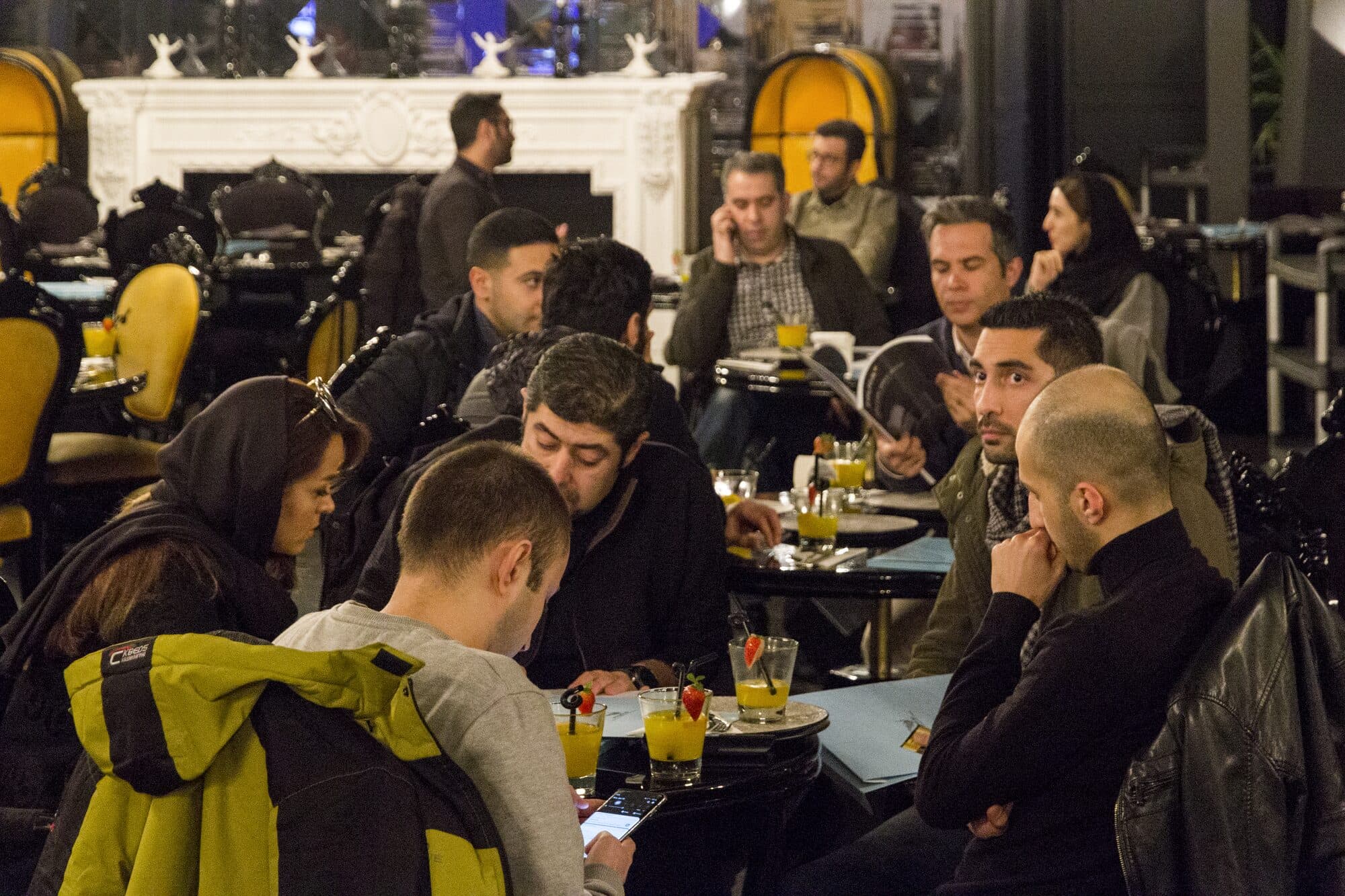
The set, the lighting, the hospitality, the film crew, the photography — all of it made to the level WINDOW itself would have to reach, because on that night the evening was WINDOW. It was the only instance of it in existence.
This is the discipline most launches fail. A company promises a premium product and serves the announcement on a folding table, and the audience — correctly — believes the table, not the promise. The gap between how you launch a thing and what you claim the thing will be is read instantly, and it is read as the truth. There is no such thing as a rough presentation of a refined idea. The presentation is the idea, until the idea exists.
06
Sell nothing. Film everything.
No price list. No floor plan on the wall. No contracts on the night. The evening's only product was a question the guests left with: how do I get into this?
Meanwhile we filmed and photographed it properly — not as documentation, but as the marketing asset the brand did not otherwise have. It solved the launch paradox exactly: a new brand cannot show a past, so we spent one night manufacturing one. From the following morning WINDOW had footage of a full, elegant room of named industry leaders paying attention to it — which is the single most persuasive thing a first-edition organiser can put in front of the four hundred companies it now has to call.
The sales conversation still happened. It just happened afterwards, on the phone, to people who had already stood inside the answer. And it was a different conversation, because we were no longer asking them to imagine something.
The film cut from the launch night, January 2020Music, no speech.
Before WINDOW could be seen, it had to be felt.
What happened
- Square metres sold on the night
- 0
- Contracts signed on the night
- 0
- Editions designed
- 6
- Editions delivered
- 4
- Recognition
- Innovation Award, Iran's building industry — for the WINDOW format
If you are not launching an exhibition
The industry was Iranian construction. The mechanics are not.
01
Your launch sets a ceiling, not a starting line.
The first price you name and the first room you appear in decide the category the market files you under, and re-categorisation is far more expensive than positioning correctly once. Treat launch week as a permanent decision, because it is.
02
With no history, taste is the only asset you can show.
Every new brand is missing the same thing — proof — and every new brand tries to compensate with claims. Claims are what everybody without proof has. Taste is visible in four seconds and cannot be faked in a deck.
03
Build one complete instance instead of describing the whole thing.
Not a pilot, not a prototype, not an MVP with the finish removed — one small, entirely finished example of the standard, and put the people whose money you need inside it. A finished fragment persuades. An unfinished whole does not.
04
Who you put on stage is your positioning statement.
Not what they say — the fact of who is standing there. Founder, salesperson, engineer, architect, customer: the market reads the casting and draws its conclusion before the first sentence.
05
Your first customers do not buy your message. They buy the room.
Especially in a connected market. Spend your launch budget on who is present rather than on what is announced, and let the guests do the persuading you cannot credibly do yourself.
06
Manufacture the past you do not have.
A launch night is the only opportunity a new brand ever gets to generate a history before it has one. Film it properly, and by morning you own the proof you spent the whole night wishing you already had.
We did not launch an exhibition that night. We built the waiting for one.
You already know what you need.
Forty-five minutes, the real problem, a point of view and a first move.